Section 1 — The Puzzle
When Europe rearms, it buys American. The United States supplied 64 percent of European NATO arms imports in 2020–2024, up from 52 percent, as imports across the continent surged 155 percent after 2022 (SIPRI 2025). That is what alliance with a superpower looks like, and it surprises no one.
So here is the part that should: why, with the giant right there, do so many European eyes keep turning towards Israel? Why do the continent's own defence-tech champions study Israeli defence-tech, and why do governments keep buying from it even through the political friction of the war in Gaza or Iran? Europe took the majority of Israel's defence exports in 2024 (Israeli Ministry of Defence 2025; Shea 2024); in 2023, Germany bought Israel's Arrow 3 interceptor, the largest defence deal in Israeli history. If the United States is the big supplier, why does the small one matter this much? And why can't we build it ourselves?
It starts to make sense when you look at the architecture beneath it all. The European Union had no commissioner whose sole job was defence until December 2024. The work existed, but it lived inside the Directorate-General for Defence Industry and Space (DG DEFIS), which filed defence beside space and the civil industrial base. In Brussels, defence and defence-technology was administratively a branch of industrial policy. An org chart is a worldview written down. Europe placed defence next to space and industry because that is how it had learned to see it: as something woven into commercial life, drawn from the same base that builds airliners and satellites. Airbus is the prime example: a real defence capability grown out of a civil-aviation champion, and until recently owned by no one in particular.
Israel began from the other end. From 1948 it treated defence not as a branch of the commercial economy but as the first priority the rest was arranged around. That premise built institutions, and those institutions built the edge Europe now shops for. That is the puzzle this paper takes up: why the state that treated defence as survival built what the continent that treated it as commerce still has to import.
The argument of this paper is that the difference is ownership, not budget. Europe and Israel both run the same modern mechanism: civilian innovation pulled deliberately into military use; but only Israel built institutions whose job was to do it. Its fusion was owned; Europe's was left to happen. Seen through that lens, the Commission's late, space-adjacent handling of defence and the continent's fragmented, home-biased procurement turn out to be the same failure at two levels, which is why the real constraint on European defence is political, not fiscal.
Section 2 — The Mechanism: Where the Edge Comes From Now
Throughout the Cold War, military research set the frontier and the civilian economy lived off the spillover. That has reversed. Since the 1990s the commercial sector has pulled far ahead. Venture capital (VC) rose from about $52 billion a year in 2010 to $171 billion in 2017, and by 2018 the five largest technology firms out-spent every OECD country's defence research put together (Reuven and Shamir 2025). The technological edge that decides modern wars is now born in the commercial economy, and any serious military has to reach in and pull it out. This mechanism is often referred to as dual-use, open innovation, or fusion. Both Israel and Europe live off it, making them comparable in the first place.
But dual-use is not a magic word that pays out just for using it. Reaching into the civilian economy does not by itself produce military strength, because the value in a dual-use technology is not baked into the technology itself. It lives in the organisation that adapts it, and the same tool can become a weapon in one system and go nowhere in another (Cowan and Foray 1995). Civilian technology arrives powerful but unfinished, short of the robustness a battlefield demands, so someone has to do the work of maturing and integrating it (Reuven and Shamir 2025). A spillover no one captures is lost potential. It can even be a sign that the fusion failed rather than succeeded: value that leaked out because no one was built to catch it (Cowan and Foray 1995).
So strength comes from owning the fusion, not from the fusion itself. The decisive variable is not the size of a country's defence budget, nor even the size of its tech sector; it is whether a state builds the machinery to pull civilian innovation into defence on purpose. And noticing the shift was never the hard part: the military's share of the microelectronics market had already fallen from all of it in 1962 to barely a tenth by the mid-1980s (Cowan and Foray 1995). What separates the strong from the rest is not that they saw the reversal coming, but that some built institutions to answer it while others left the answer to chance, which is the whole distance between Israel and Europe.
Section 3 — Israel: Fusion With an Owner
Every military now faces the same job: reach into the civilian economy and pull its technology into defence. Israel is the state that built machines to do exactly that, on purpose. Because it treated defence as the condition of its survival rather than a branch of its economy, the harvesting was never left to chance. It became somebody's job, written into an org chart. The result is large relative to the country's size. Three Israeli firms rank among the world's hundred largest arms producers: Elbit, Israel Aerospace Industries, and Rafael. Research at the leading firms often exceeds a third of revenue, and Israel holds about 2.3 percent of the global arms market, nearly five times its share of world exports (Evron 2025).
That strength rests on two things, and the order matters. The first is pressure. Surrounded by rivals and unable to out-produce them in every category, Israel made a choice after it cancelled the Lavi fighter in 1987. It gave up full platform independence and specialised in force-multipliers: drones, the Iron Dome interceptor, command and intelligence systems, electro-optics, and cyber (Evron 2025). What Israel cannot acquire in resources or scale, it compensates for with edge. A structural squeeze locked the choice in. Under the 2016 aid agreement, the share of US assistance Israel may spend at home falls to nothing by 2028, which drives its firms towards exports and towards the niches where they lead. But pressure alone produces nothing, and plenty of threatened states stay weak. The second thing is what Israel built to capitalise on the pressure.
Israel built institutions whose sole job is the harvest. MAFAT, the Directorate of Defence R&D, exists to scan the civilian economy for firms and technologies that can be pulled into defence work. The Israel Innovation Authority is a second body, built to converge civilian technology with weapons development. Programmes like Meimad and Innofense fund dual-use development aimed squarely at startups and universities (Evron 2025). Figure 1 sets out the shape this produces: survival pressure at the top, a single owner beneath it, standing bodies to run the work, and startups at the base, with technology pulled upward into defence. The structure is old and not improvised. The Innovation Authority descends from an earlier body, MATIMOP, reconstituted in 2016. Its founder was a former commander of the army's weaponry-development division. The institutions that now cultivate civilian innovation were seeded from inside the defence establishment, which is strong evidence the fusion was owned, not lucky.
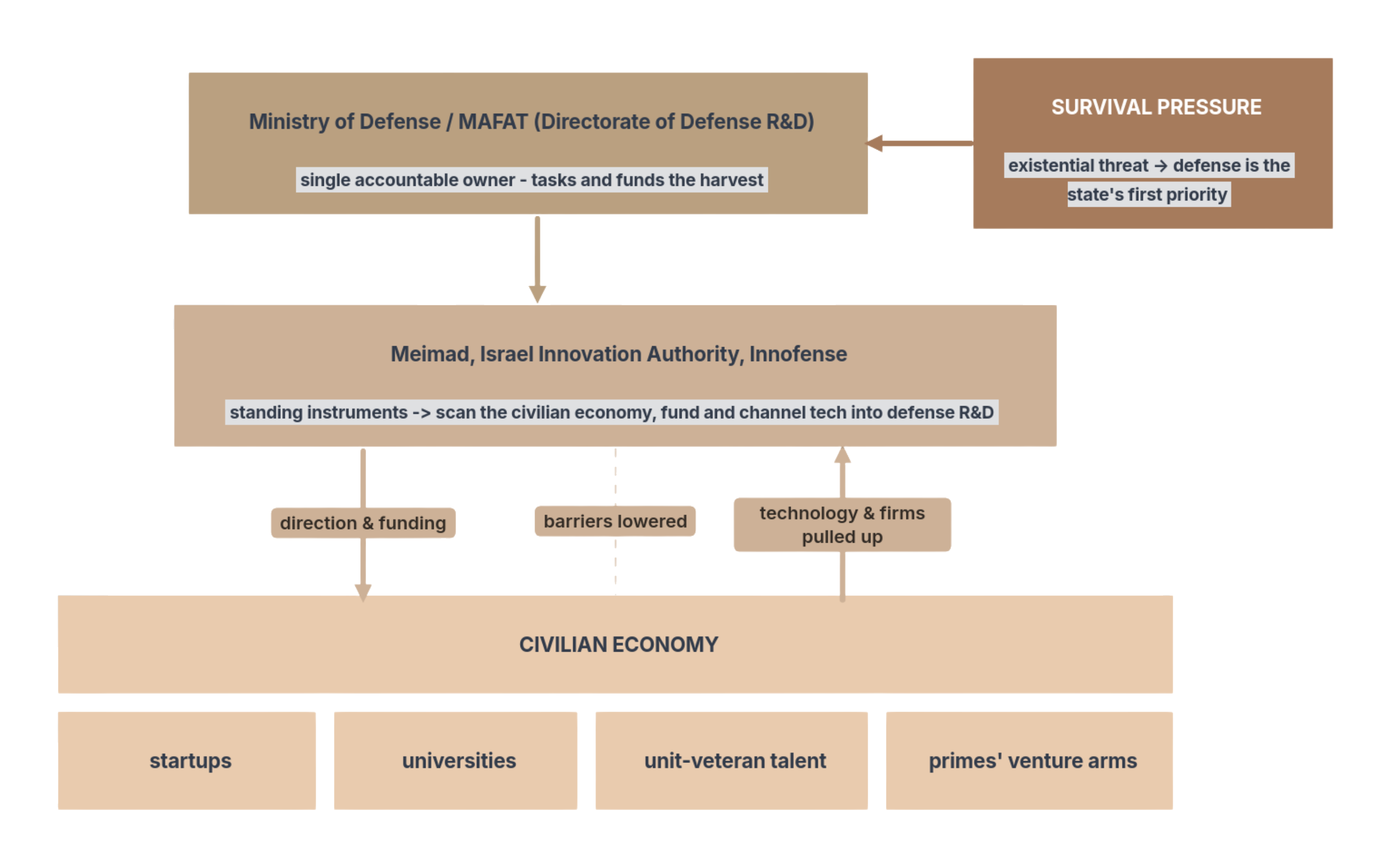
It is important to name the exact mechanism the machinery uses to achieve ownership. Primarily, Israel keeps lowering the barrier to entry. The Defence Ministry broke large projects into smaller bids so that startups could compete, and it cut licensing that once took a year down to fifty business days. In the late 2010s its posture changed from passive to active. Instead of tracing promising civilian technologies, its agencies began actively ushering them in (Evron 2025). The harvest had become standard procedure, not opportunism. Talent and incumbents complete the circuit. Veterans of elite military-technology units carry their skills straight into startups, and the primes now run the pull themselves through corporate venture arms. During the recent war, the apparatus scaled up. The R&D directorate pulled more than 130 startups into wartime development, and private investment in Israeli defence startups passed a billion dollars in a single year (Israel Ministry of Defence 2025).
None of this is clean, and Israel does not pretend it is. Evron lists the strains plainly. Classified information is hard to secure inside civilian firms. The costs of defence work deter small companies. Nimble entrants threaten the established primes (Evron 2025). The fusion is cultivated and contested at once, a mix of deliberate programmes and organic migration rather than a master plan drawn up in 1948. But it is owned, which is the variable this paper is tracking. Israel and Europe face the same task and answer it with opposite architectures. Israel built a dedicated vertical structure to own the fusion. Europe scattered the same function sideways into industrial policy.
Section 4 — Europe: The Same Machine, Nobody at the Controls
Section 3 showed a harvest with an owner. Europe shows a harvest that runs by itself. The mechanism is not absent, and I am not claiming that Europe is weak. The point is subtler than either, and worse. If there is one sentence you should take from this paper, it is this:
Europe sits on one of the world's largest civilian technology economies, and the same civilian-to-military spin-in runs through it exactly as it runs through Israel. And still Europe comes out weaker, because the engine is unowned. Not absent. Not weak. Unowned.
The proof is continental, not anecdotal. Europe generates world-class civilian innovation and then fails to keep it. More than a third of Europe's technology unicorns relocate abroad, most of them to the United States, driven out by fragmented finance and regulation (Draghi 2024). This is the warning from Section 2 made literal. The innovation is real, but nothing is built to capture it, so it leaks away. A spillover no one owns is not strength. It is potential that got away.
The missing piece is an owner of the fusion. Europe has no MAFAT and no DARPA, no central body whose job is to steer civilian breakthroughs into defence. As one analyst notes, what most sets DARPA apart is its transfer of technology into the defence ministry, and Europe's fragmented procurement stops the state from absorbing breakthrough innovations (Matthews 2025). Europe knows the seat is empty. The Draghi report calls for a European research-projects agency and a central defence-industry authority to do the steering that no one now does (Draghi 2024). You do not propose building an owner unless one is missing. Therefore, Europe is not missing the engine. It is missing the driver.
Airbus shows what unowned strength looks like. It is real, but uneven and unclaimed. Where the mission is homogeneous and the governance centralised, as in civil aviation, it succeeds enormously. On complex military programmes it strains, because the requirements fracture across national governments that each want their own share of the work. The A400M transport, the Future Combat Air System, and the Eurodrone have all run late and over budget (AeroMorning). Europe's states built a superb aviation company, on decades of public subsidy and coordination. What they did not build was an owner of the fusion and therefore a driver who could steer those developments into defence.
This is finally starting to change, but barely. European dual-use and defence funds are only now taking shape, and the very calls for a central defence-industry authority are an admission that no one owned this before. They are the first tentative machinery for steering civilian innovation into defence on purpose. The deeper fact is how long that took. Europe went almost its entire history without this owner. Only now, under external pressure, has it begun to build one. What that pressure was, and the institutional scramble it set off, is the subject of the next two sections.
Section 5 — The Confession in the Org Chart
Section 4 showed that Europe's fusion runs without an owner. A sceptic could still shrug and say that markets are simply like that, unsteered by nature. This section removes that escape. It moves the argument from how the market behaves to how the European Union is wired, and there the missing owner is not a behaviour but a design. Start with a simple idea. An organisational chart is not neutral plumbing. When an institution decides where a function lives, which department owns it, which law governs it, and what it sits next to, it is revealing what category that function belongs to in its own mind. Where you file something is a confession of what you think it is.
So read the filing. Defence does not get a directorate of its own. It is bundled with space, inside the Directorate-General for Defence Industry and Space, and that directorate's own work programme is organised around synergies among civil, defence, and space industries (DG DEFIS 2024). Nothing here treats defence as a sovereign necessity with its own logic. It is handled as one more industrial sector, sitting beside satellites and airframes, to be coordinated with them for market efficiency.
The legal foundation cuts deeper, and it is harder to wave away as an accident of org-chart tidiness. Europe's defence-industrial legislation proceeds under Article 173 of the Treaty (Clapp 2024). Article 173 is the article on industrial competitiveness and the internal market. It is not a security article. It is not a defence article. It is the competitiveness article.
At the deepest level of its own law, the level that shapes everything built above it, the European Union processes defence as a competitiveness problem.
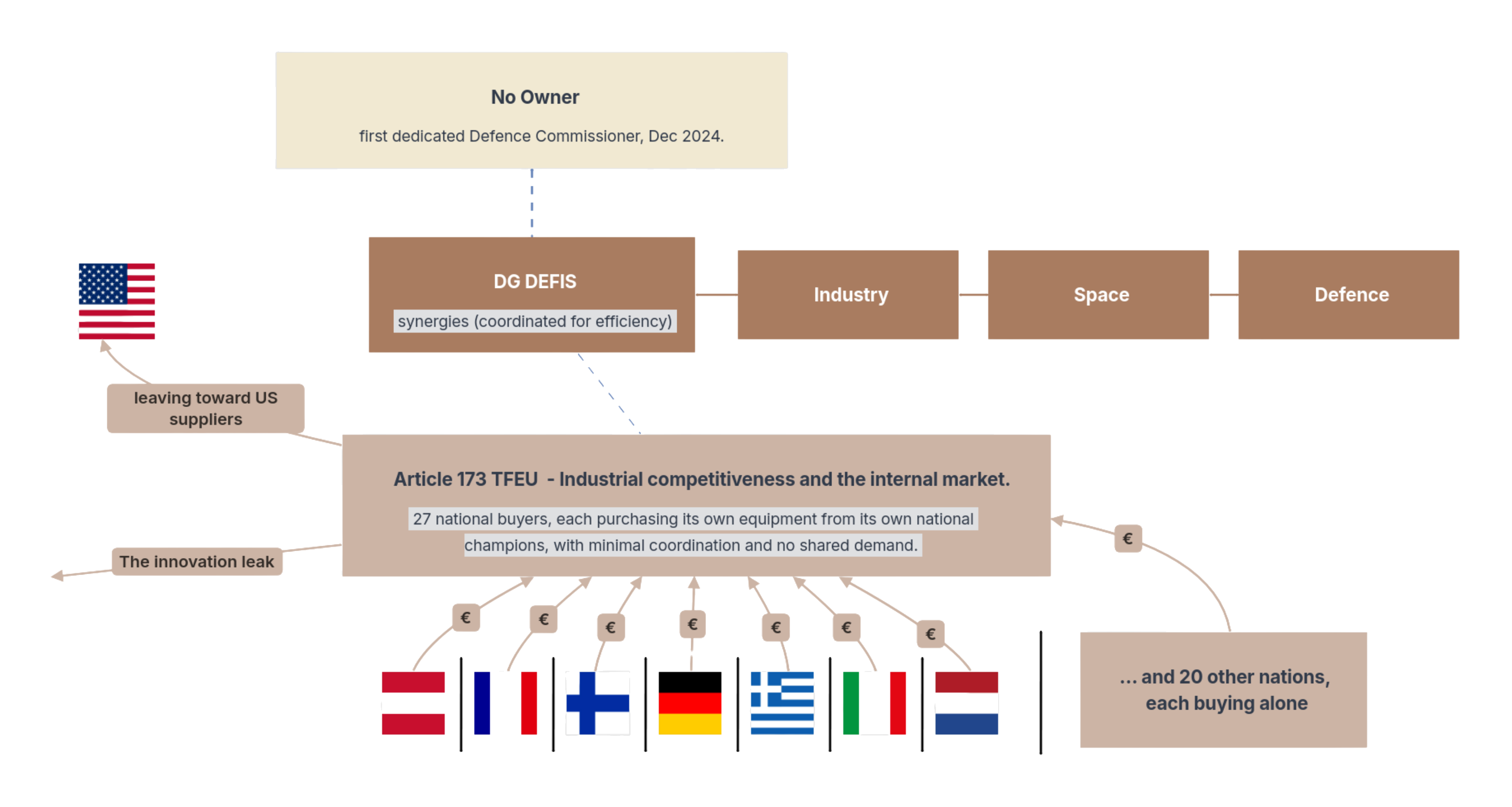
Figure 2 sets Europe beside Israel in the same grammar: no owner at the top, defence filed sideways beside space and industry, the whole structure resting on internal-market law, with innovation leaking out instead of being pulled in.
The org chart tells you how Europe filed defence. The calendar tells you how long it was content to leave it filed that way, and this is where the argument becomes hard to deny. The Union traces to 1951 and has run a single market, a currency, and a diplomatic service for decades. Yet it appointed its first-ever dedicated Commissioner for Defence, someone whose sole job is defence, only in December 2024, and only after the invasion of Ukraine. Israel had a defence ministry driving its technological base from 1948. Europe acquired a defence commissioner in 2024. The gap between those two dates is not trivia. It is the difference between an owned fusion and an unowned one, made visible.
Two honest limits keep this from overreaching. The DEFIS work programme is a statement of intent, not a record of outcomes, so it is read here for what it reveals about how the Commission conceives the portfolio, not for what it has delivered. And a single directorate cannot be read as though the Commission runs European defence, because it does not. Defence remains overwhelmingly a matter for the member states, exercised through a security and defence policy established only in 1999 (Clapp 2024). The claim is narrower and sharper than Commission supremacy. It is that when Europe finally did file defence, it filed it as industry.
The direction all this points is not an idiosyncratic reading. Håkansson finds the same turn in the scholarship, observing that the logic of European integration shifted from a primarily market-driven to a security-driven rationale in the 2020s, and locating within that shift an expanded role for the Commission built through years of steady policy entrepreneurship (Håkansson 2026). The org chart and the calendar are the visible residue of that shift. Europe is moving from treating defence as commerce to treating it as security. What forced that move, and how frantic it has been, is the subject of the next section.
Section 6 — The Chair Gets Filled
War on the continent is doing to Europe quickly what insecurity did to Israel slowly. For seventy years Israel was squeezed into building an owner of its fusion. Europe is being squeezed into the same thing in two or three. The pressure is cruder and the work is rushed, but the mechanism is the same. Pressure forces ownership. This is why the European failure was never permanent. It was a failure waiting for a trigger, and the invasion of Ukraine was the trigger.
The change is easiest to see in the money. The combined defence budgets of EU members climbed from €240 billion in 2022 to an estimated €290 billion in 2023 and €350 billion in 2024 (Clapp 2024). New machinery appeared alongside the money. Europe adopted its first-ever European Defence Industrial Strategy in March 2024, stood up an initial defence-industry programme, enlarged the European Defence Fund, and built joint-procurement and ammunition instruments known as EDIRPA and ASAP (Clapp 2024). After decades of leaving the chair empty, the Union was suddenly scrambling to fill it.
But the spending is not the sharpest marker of the turn. Numbers going up are just numbers going up. The sharpest marker is a line the Union crossed. In February 2022, for the first time in its history, the EU agreed to finance the supply of lethal weapons to a state at war (Clapp 2024). That is not accounting. That is the Union doing something it had never been willing to do, and deciding what kind of actor it is prepared to be. The shift in identity is qualitative, not quantitative.
The same pressure that triggered the surge exposed how hollow the foundation underneath it had become. Ukraine's demand instantly outran Europe's ability to produce. Artillery ammunition was the clearest case. European production of 155mm shells, around 230,000 a year, sat far below what the war required, below the targets of more than a million for 2024 and two million for 2025, and far below Russian output (Lundmark 2026). This was not simple underinvestment. Europe's defence industry had been deliberately optimised for peace, built to run lean in a world where war on the continent was unthinkable. The shell shortage is not a side detail. It is the physical proof of Section 5. A continent that files defence as a competitiveness problem builds an industry that is efficient in peacetime and empty in war.
The fixes now on the table reach precisely towards the ownership Europe has lacked. A defence-industrial strategy, joint procurement, a central authority to buy on everyone's behalf: each one is an attempt to put a hand on the wheel. The direction of travel is towards an owner. Whether Europe actually gets one is the question Section 8 takes up, because building the machinery is harder than wanting it.
Germany is the sharpest single instance of the turn, and of its central flaw. The scale of the 'Zeitenwende' is unmistakable, a rearmament measured in the hundreds of billions. But here is the paradox: a large share of the new German money buys equipment off the shelf from the United States, the F-35 and the Patriot among it (Mueller 2025). The effect is to deepen dependence on American supply and, worse, to increase fragmentation rather than reduce it. The demand shock is real, but much of it is flowing across the Atlantic instead of into a European base. The raw numbers show it: imports by states in Europe rose 155 percent, and the United States now supplies 64 percent of European NATO's arms, up from 52 percent (SIPRI 2025).
Europe now wants to own its defence. It has the money and the political will. What it does not yet have is the machinery to turn that will into a coherent European capability and strategy, rather than twenty-seven national shopping sprees at the American store, which quite frankly only deepens fragmentation and erodes European sovereignty.
Section 7 — One Failure, Two Levels
The obvious explanation is that Europe simply spent too little for too long, the famous peace dividend finally coming due. But the simple explanation is wrong. Money has stopped being the binding constraint. There is now a €150 billion joint borrowing instrument, a summit pledge to push core defence spending towards 3.5 percent of output with another 1.5 percent on top, and EU members already allocated €343 billion to defence in 2024, a sum second only to the United States (Nemeth, Dorman, and Unger 2025). If the money is flowing and Europe is still weak, then money was never the real lock. But what is?
The real constraint is the shape of the demand, not its size. The problem is not how much Europe spends. It is how it spends. There is no single European market. Roughly 90 percent of defence research and 80 percent of procurement still happens nationally (Mueller 2025). Europe researches on its own and buys in fragments: in 2023 about three-quarters of defence contracts went to domestic firms, only 19 percent to a firm in another member state, and a bare 6 percent outside the Union (Cernat, Guinea, and Preuss 2025).
Picture what that means on the ground. Twenty-seven countries each buy their own small batches of their own slightly different equipment from their own national champions. As recently as 2022, only 18 percent of equipment spending was collaborative, against a 35 percent benchmark set years earlier that was never met (Nemeth, Dorman, and Unger 2025). Nobody pools. Nobody aggregates. The demand is shattered into twenty-seven pieces.
Here is the sentence the rest of this paper was built to earn. This is the same ownership failure as the under-institutionalised fusion, now seen at the level of demand. In Section 4 no institution was in charge of harvesting the fusion. Here no mechanism aggregates the demand. The two are one failure at two levels. Two sides of one coin.
Fragmentation on this scale is not merely wasteful. It is self-defeating, and it is worth seeing the machine. Absent pooling, extra demand mainly drives up prices instead of buying more capability (Wolff, Steinbach, and Zettelmeyer 2025). Each national champion is a small monopoly inside its protected home market, so when the government pours in more money, the supplier raises the price rather than the output. Running defence this way has a price. The cost of non-cooperation runs somewhere between €20 and €100 billion a year (Mueller 2025).
The upside of fixing it is large, but conditional. Integration plus scaled-up demand could cut unit costs sharply, by as much as a half to nine-tenths for items whose demand rises steeply, on the logic of learning curves and the analogy to wartime production (Wolff, Steinbach, and Zettelmeyer 2025). But those savings appear only if competition forces them into prices. Pool the demand without opening the market, and the national champions simply capture the gains as profit. Scale is not the lever on its own. Competition is.
What holds the fragmentation in place is not economics. It is law and politics. Article 346 of the Treaty preserves a national-security exception that effectively lets member states write their own procurement rules, the escape hatch through which they dodge EU-wide competition whenever they choose (Mueller 2025). Beneath the law sits the real driver. It is the wish to preserve national sovereignty in defence, which the scholarship names as the single most consistent reason for reluctance to cooperate across two decades (Mueller 2025). It shows up in the buying. Germany and France purchase more than 80 percent of their equipment at home, because a national champion is also national jobs (Wolff, Steinbach, and Zettelmeyer 2025). This is why the constraint is ultimately political, not fiscal.
There is a demand-side counterpart to the institutions Israel built, and it is starting to appear. Market-style scaling is the realisation layer now forming in Europe: venture capital, competitive tendering, dedicated dual-use funds (Reuven and Shamir 2025). But capital is subordinate to procurement, not a substitute for it. Money poured into twenty-seven fragmented buying systems still strands the firms it is meant to lift. Every defence market in the world has a single buyer. Israel's advantage was a buyer that was fast, integrated, and motivated. Europe's problem is a buyer split into twenty-seven, each one slow and each one shopping at home.
Section 8 — The Cure Is Contested, and That Proves the Point
On the diagnosis, the literature barely disagrees. Fragmentation, home bias, and Article 346 turn up wherever anyone looks (Wolff, Steinbach, and Zettelmeyer 2025; Scazzieri 2025; de Cordoue 2026). The problem is settled. The cure is where the field breaks apart, and the way it breaks apart is the point.
The break runs along a single question: whether Europe should build the owner or coax it into being. Build it, and you need a treaty-based mechanism that overrides the Article 346 escape hatch and buys on everyone's behalf, on the reasoning that modest incentives will never overcome national instinct (Wolff, Steinbach, and Zettelmeyer 2025). Coax it, and you accept that any owner imposed from above will be strangled by the member states, so you make cooperation the profitable choice and let the market pull itself together (Scazzieri 2025). Build it or coax it. Neither side can prove it is right without first winning a political fight.
That is the tell. Both cures are really bets about what the member states will tolerate, which means the obstacle each is trying to clear is neither economic nor legal but political. Secure the political agreement, one study notes, and the economic and regulatory problems become largely surmountable (Nemeth, Dorman, and Unger 2025). The disagreement is not a hole in the research. It is the research arriving, from opposite directions, at the same lock: sovereignty. This paper does not need to crown the winning cure. The absence of a winner is the final proof that the constraint was political all along.
Section 9 — The Puzzle, Answered
Return to where this started. A continent that dwarfs Israel in wealth and industry still buys its shield from a state smaller than New Jersey, and keeps buying through political strain. The answer is now in hand. Europe reaches for Israel in the niches not because it lacks capability but because it never owned its fusion. Israel's institutions were the ownership. The same engine ran on both sides, and only one side built a hand to steer it.
What Israel built slowly under seventy years of pressure, Europe is now trying to build quickly under its own. The budgets are real, the strategies are drafted, and a defence commissioner is finally in the chair. But intent has arrived ahead of capacity, and the money is still flowing into twenty-seven national systems instead of one European base. Europe has decided it wants to own its defence. It has not yet built the machinery to do it.
Whether it closes the gap will depend less on how much it spends than on whether it fixes how it buys, and on whether it stops filing defence beside space and starts treating it as a domain that owns itself. The logic of European integration is already turning from market to security (Håkansson 2026). The org chart has not caught up. When it does, the puzzle this paper began with will not just be answered. It will be obsolete.
References
AeroMorning. (2025). European industrial governance: Why the Airbus model succeeds in civil aviation but reaches its limits in combat and innovation systems. https://aeromorning.com/en/european-industrial-governance-why-the-airbus-model-succeeds-in-civil-aviation-but-reaches-its-limits-in-combat-and-innovation-systems/
Cernat, L., Guinea, O., & Preuss, H. (2025). Openness and fragmentation in EU defence procurement. European Centre for International Political Economy (ECIPE). https://ecipe.org/publications/openness-and-fragmentation-in-eu-defence-procurement/
Clapp, S. (2024). Hearings of European Commissioners-designate: Andrius Kubilius — Defence and Space (Briefing No. PE 762.437). European Parliamentary Research Service, European Parliament. https://www.europarl.europa.eu/RegData/etudes/BRIE/2024/762437/EPRS_BRI(2024)762437_EN.pdf
Cowan, R., & Foray, D. (1995). Quandaries in the economics of dual technologies and spillovers from military to civilian research and development. Research Policy, 24(6), 851–868. https://doi.org/10.1016/0048-7333(94)00802-J
de Cordoue, B. (2026, January 23). For its defence, Europe needs an armament single market [Blog post]. Institut Jacques Delors. https://institutdelors.eu/en/publications/for-its-defence-europe-needs-an-armament-single-market/
Directorate-General for Defence Industry and Space (DG DEFIS). (2024). Management plan 2024. European Commission. https://commission.europa.eu/document/download/29cbef21-9006-420b-a424-6a4924e545d1_en
Draghi, M. (2024). The future of European competitiveness: A competitiveness strategy for Europe. European Commission. https://commission.europa.eu/topics/eu-competitiveness/draghi-report_en
Evron, Y. (2025). Israel's defence industry: Adaptation and growth in a changing arms market. Defence Studies, 25(2), 301–321. https://doi.org/10.1080/14702436.2025.2472720
Håkansson, C. (2026). The European Union's evolving defence-industrial policy: Drivers and future challenges. In K. Edholm, B. Lundqvist, A. Michalski, & L. Oxelheim (Eds.), The EU charting its course in a geopolitical world. Springer. https://doi.org/10.1007/978-3-032-18648-5_6
Israel Ministry of Defense, International Defense Cooperation Directorate (SIBAT). (2025). Israel's defense exports in 2024. Israel Ministry of Defense.
Kon, [I.]. (2025). Interview on Israeli wartime defence development [Interview]. Directorate of Defense Research and Development (DDR&D), Israel Ministry of Defense.
Lundmark, M. (2026). European strategic autonomy in the field of defence: Reconfiguration of military supply chains following Russia's full-scale invasion of Ukraine in 2022. In K. Edholm, B. Lundqvist, A. Michalski, & L. Oxelheim (Eds.), The EU charting its course in a geopolitical world. Springer. https://doi.org/10.1007/978-3-032-18648-5_7
Matthews, D. (2025, February 11). EU DARPA equivalent must be independent, experts say. Science|Business. https://sciencebusiness.net/news/r-d-funding/european-innovation-council/eu-darpa-equivalent-must-be-independent-experts-say
Mueller, T. (2025). Drivers and impact of European defence market integration: A literature meta-synthesis with economic focus. Defence and Peace Economics, 36(5), 577–612. https://doi.org/10.1080/10242694.2024.2396416
Nemeth, B., Dorman, A., & Unger, A. (2025). Tackling barriers to the single market for defence (Study No. PE 775.283). European Parliament, Directorate-General for External Policies.
Reuven, N., & Shamir, E. (2025). The shift in technological dominance and the adaption of open innovation by the defence sector. Defense & Security Analysis, 41(3), 392–415. https://doi.org/10.1080/14751798.2025.2484920
Scazzieri, L. (2025). Towards an EU 'defence union'? [Policy brief, 30 January]. Centre for European Reform. https://www.cer.eu/publications/archive/policy-brief/2025/towards-eu-defence-union
Shea, J. (2024). [Quoted in] European defence, brought to you by Israel. The European Correspondent.
Stockholm International Peace Research Institute (SIPRI). (2025). Trends in international arms transfers, 2024 [Fact sheet]. https://www.sipri.org/sites/default/files/2025-03/fs_2503_at_2024_0.pdf
Wolff, G., Steinbach, A., & Zettelmeyer, J. (2025). The governance and funding of European rearmament [Policy brief 15/2025]. Bruegel. https://www.bruegel.org/policy-brief/governance-and-funding-european-rearmament